The complete guide to AI audiobook production (2026)
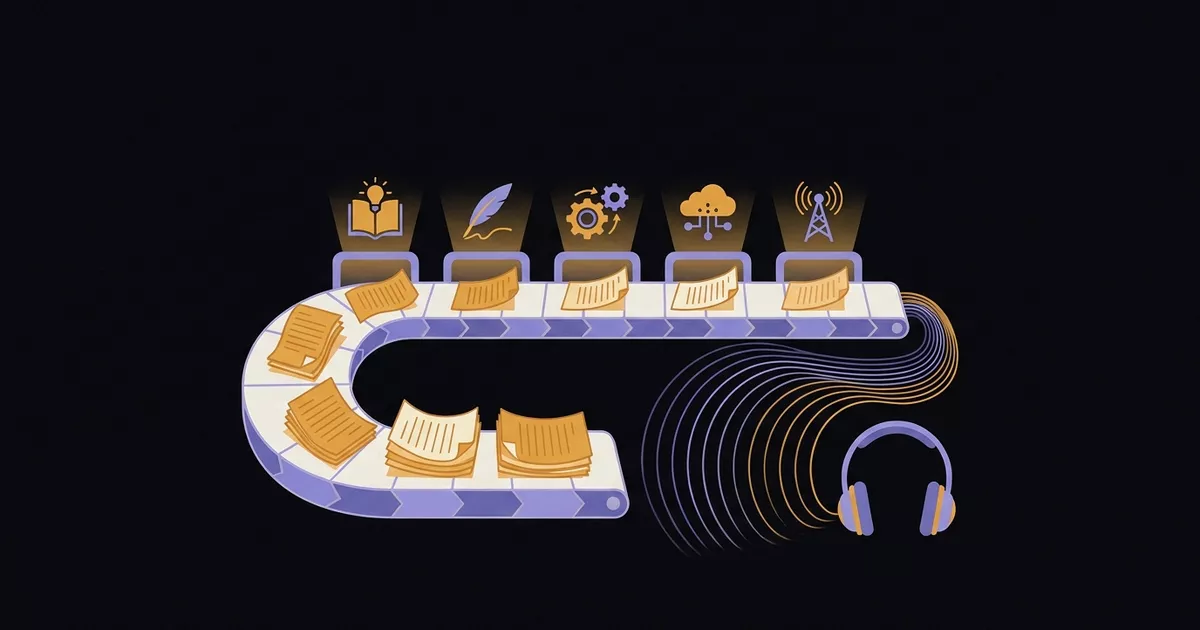
An AI audiobook production platform turns your manuscript into a finished audiobook in five steps: you upload an EPUB, pick a voice, the AI narrates every chapter, you review and request revisions, then you download chaptered M4B and MP3 files to distribute. With TomeVox that takes under 24 hours and costs $49 to $99 Narrated or $149 to $299 Performed, against $1,200 to $4,000 for a human narrator.
You make three decisions (the file, the voice and any revisions); the platform does the narration, chapter markers and mastering.
| Step | What you do | What the platform does |
|---|---|---|
| 1. Upload | Provide an EPUB (convert DOCX or PDF first) | Extracts chapters, front matter and back matter |
| 2. Select a voice | Preview voices in 13 languages and pick one | Uses that voice for the whole book |
| 3. Generate | Nothing | Narrates with context-aware tone and pacing, adds chapter markers, masters the loudness |
| 4. Review and revise | Listen and flag mispronunciations or pacing | Regenerates only the chapters you flag |
| 5. Download and distribute | Upload the files to your stores | Delivers chaptered M4B and MP3 files |
In this guide
- Why produce an audiobook in 2026?
- AI narration vs human narration
- How AI audiobook production works
- Preparing your manuscript
- What it costs
- How long it takes
- Technical specifications and quality standards
- Where to distribute your audiobook
- Choosing the right AI audiobook tool
- Your audiobook production checklist
1. Why produce an audiobook in 2026?
The audiobook market generated $9.3 billion in revenue in 2025, growing 9% year-over-year. Audiobook listeners in the US alone increased from 45% of the population in 2023 to an estimated 50% in 2025. Meanwhile, most books, especially indie-published titles, still have no audio edition. That gap between listener demand and catalog availability is the opportunity.
The business case
An audiobook edition doesn't cannibalize print or ebook sales. Research from the Audio Publishers Association consistently shows that audiobook listeners are incremental buyers: they listen during commutes, workouts, and chores when reading isn't an option. Adding an audio edition expands your addressable market to people who wouldn't have bought your book otherwise.
For indie authors producing multiple titles per year, the math is straightforward: every book without an audio edition is leaving money on the table. The question used to be whether the investment made sense: human narration for a full-length novel costs $1,200 to $4,000 ($4,000 to $7,000+ through a full-service company). With TomeVox, the per-title cost drops to $49 to $99 Narrated or $149 to $299 Performed, making the ROI calculation trivial.
Discovery and discoverability
Audiobook distributors represent additional discovery surfaces. A listener browsing Audible, Apple Books, or Spotify won't find your book unless an audio edition exists. Each platform is another storefront, another search result, another recommendation algorithm working for you.
2. AI narration vs human narration
The first decision in any audiobook project is who narrates it. In 2026 you have two viable options: hire a human voice actor, or use AI text-to-speech. Both produce professional-quality results, but they differ significantly in cost, speed, and creative control.
When AI is the right choice
- Budget matters. AI narration costs 95–99% less than human narration.
- You need speed. AI delivers a finished audiobook in hours; human narration takes 4–8 weeks.
- You're producing multiple titles. The per-title economics of AI make it practical to produce your entire backlist.
- You want consistency. AI doesn't have off days, mic drift, or session-to-session variation.
- You need easy revisions. Revision rounds are included (2 Narrated, 3 Performed); re-recording with a human costs hundreds per hour.
When human narration is the right choice
- A specific narrator's name is part of your marketing. Some audiobook buyers follow narrators like they follow authors.
- You want real-time creative direction. Working with a human in a studio lets you direct specific emotional beats and pacing choices.
Modern AI narration handles emotional range, multi-character dialogue, and genre-specific tone, including fiction. The gap that existed in 2023 has largely closed. For a detailed, data-driven comparison with cost tables and real examples, read our full guide: AI audiobook narration vs human narrator: an honest comparison.
3. How AI audiobook production works
AI audiobook production follows a straightforward pipeline. Understanding each step helps you get the best result.
Step 1: Upload your manuscript
You provide your book as an EPUB file, the standard ebook format. The system parses the file, extracts chapters, identifies front matter and back matter, and prepares the text for narration. EPUB is preferred because it carries structural metadata (chapter breaks, headings) that the AI uses to produce proper pacing and chapter markers.
If your book is in a different format (DOCX, PDF, plain text), you'll need to convert it to EPUB first. Most writing tools export EPUB natively. Calibre is a free option for conversion. For a walkthrough of conversion methods and common pitfalls, see: How to convert an EPUB to audiobook: 3 methods compared.
Step 2: Select a voice
You choose from AI voices in 13 languages (Arabic, Chinese, English, French, German, Hindi, Italian, Japanese, Korean, Portuguese, Russian, Spanish, and Swedish), each with distinct characteristics: pitch, pacing, warmth, and accent. Preview clips let you audition voices against a sample of your text before committing. The voice you select narrates the entire book consistently.
Step 3: Generate
The AI reads your manuscript and produces a full narration. This includes:
- Emotional performance. The model adjusts tone, pacing, and emphasis based on sentence context: tension in thriller scenes, warmth in memoirs, energy in dialogue.
- Chapter markers. Each chapter is automatically segmented with metadata markers that players use for navigation.
- Consistent audio quality. Output is mastered to broadcast standards: proper loudness normalization, noise floor, and dynamic range.
Step 4: Review and revise
Listen to the output. If any chapter needs adjustment (a mispronounced proper noun, a passage that needs different pacing), you can regenerate individual chapters without re-processing the entire book. TomeVox includes 2 revision rounds for Narrated and 3 for Performed, and a person reviews every audiobook before delivery.
Step 5: Download and distribute
You receive your audiobook as chaptered M4B and MP3 files, mastered to the loudness, peak and noise-floor specs distributors publish. Which stores accept AI narration is covered in section 8.
4. Preparing your manuscript
The quality of your audiobook depends partly on how clean your manuscript is. AI narration is literal: it reads what's on the page, including formatting artifacts, stray characters, and inconsistencies that a human narrator might silently correct.
Format: EPUB is best
EPUB preserves chapter structure, heading hierarchy, and semantic markup. This gives the AI the context it needs to pace chapter transitions, identify dialogue, and apply appropriate emphasis. PDFs and DOCX files can work but lose structural information.
Clean your text
- Remove headers and footers that appear on every page (page numbers, running titles). These will be read aloud.
- Check for OCR artifacts if your source was scanned. Common issues: "rn" rendered as "m", "1" as "l", broken hyphenation.
- Spell out abbreviations that should be spoken as words. "Dr." is fine (the AI handles it), but domain-specific abbreviations may be read letter-by-letter.
- Add pronunciation hints for unusual proper nouns if the platform supports it.
- Review front and back matter. Do you want the dedication, acknowledgments, and "about the author" section narrated? Remove anything that shouldn't be read aloud (ISBN pages, copyright boilerplate, etc.).
Chapter structure
Ensure your EPUB has proper chapter breaks. Each chapter should be a separate section with an identifiable heading. This is how the AI creates chapter markers in the final audiobook, and chapter navigation is a requirement for most distributors.
5. What it costs
The cost difference between AI and human narration is the single biggest factor driving adoption. Here's a realistic breakdown as of March 2026.
| Cost component | Human narration | AI narration (TomeVox) |
|---|---|---|
| Narrator / generation fee | $150 – $500 per finished hour | Included in book price |
| Editing & mastering | Usually in the per-hour rate | $0 (included) |
| Chapter markers | $100 – $300 (manual) | $0 (automatic) |
| Revisions | $200 – $800 per re-record | 2 revision rounds Narrated, 3 Performed |
| Total per book | $1,200 – $4,000 (8-hour book); $4,000 – $7,000+ full-service | $49 – $99 Narrated, $149 – $299 Performed (early bird) |
Costs as of March 2026. Human narration rates based on ACX and Findaway Voices marketplace data.
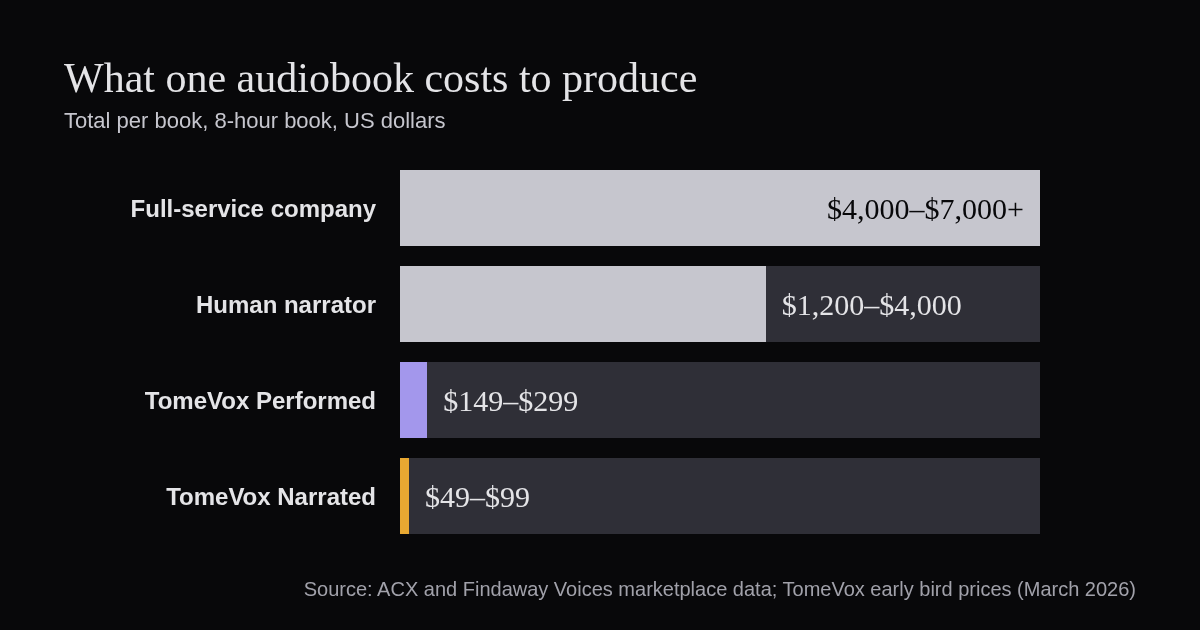
For indie authors producing 3–5 titles per year, the savings compound quickly. At human narration rates, a 5-book catalog costs $6,000–$20,000 in audio production alone. With TomeVox, the same catalog costs $245–$495 Narrated or $745–$1,495 Performed.
For a deeper breakdown with more scenarios, see: AI audiobook narration vs human narrator: an honest comparison.
6. How long it takes
AI audiobook production compresses what used to be a months-long process into a single day.
| Phase | Human narration | AI narration |
|---|---|---|
| Narrator selection / auditions | 1 – 2 weeks | Minutes (browse & preview) |
| Recording | 1 – 2 weeks | Automated (hours) |
| Editing & mastering | 1 – 2 weeks | Automated (included) |
| QA & revisions | 1 – 2 weeks | Same day |
| Total | 4 – 8 weeks | Under 24 hours |
The time savings matter beyond convenience. Faster production means you can:
- Simultaneous-launch your ebook and audiobook on the same day, maximizing launch momentum.
- Produce your backlist without taking months off from writing.
- React to market timing: seasonal titles, trending topics, timely non-fiction.
For a detailed breakdown of every phase including distributor review timelines, read: How long does audiobook production take? A realistic timeline.
7. Technical specifications and quality standards
Every audiobook distributor has technical requirements your files must meet. TomeVox masters its files to the published audio specs below, but acceptance is up to each distributor, and understanding the specs helps you verify quality and troubleshoot issues.
ACX / Audible requirements
ACX (Amazon's audiobook platform, which feeds into Audible) is the most specific about technical standards:
- Format: MP3 or M4A, 192 kbps or higher CBR (constant bit rate)
- Sample rate: 44.1 kHz
- Loudness: RMS between -23 dBFS and -18 dBFS
- Noise floor: -60 dB or lower
- Peak level: -3 dB maximum
- Each chapter must be a separate file with 0.5–1 second of room tone at head and tail
- Opening and closing credits are required ("This is [title], written by [author], narrated by [narrator]")
Apple Books requirements
Apple is less prescriptive but expects professional-grade audio. M4B (bookmarked AAC) is the preferred format. Chapter markers must be embedded. No specific loudness target is published, but content that sounds noticeably different from the catalog will be rejected.
AI disclosure requirements
Standard ACX submissions require human narration, so an AI-narrated file produced elsewhere can't be uploaded there, and INaudio (formerly Findaway Voices) does not take external AI files either. Google Play Books and Kobo accept AI-narrated audiobooks directly, with AI disclosure.
For the full spec sheet with every parameter, common rejection reasons, and how to run a quality check on your files, read: ACX technical requirements for audiobooks: the complete 2026 guide.
8. Where to distribute your audiobook
Once your audiobook is produced, you need to get it onto the platforms where listeners buy and stream audio. As of March 2026, the primary distribution options for AI-narrated audiobooks are:
ACX / Audible
Amazon's Audible is the largest audiobook retailer, estimated at 40–50% of the US market. ACX is the self-service portal for getting your audiobook onto Audible, Amazon, and Apple Books (through ACX's distribution). Standard ACX titles require human narration, so an AI-narrated file produced elsewhere can't be uploaded there.
Findaway Voices / Spotify
Findaway Voices (now part of Spotify) distributes to 40+ retailers and libraries including Spotify, Apple Books, Google Play, Kobo, Scribd, OverDrive, Hoopla, and more. It's one of the widest distribution networks, but as INaudio it does not take AI-narrated files produced elsewhere. For AI narration, upload directly to Google Play Books and Kobo, and reach Apple Books, Spotify and libraries through an AI-friendly distributor such as Author's Republic.
Direct distribution
Platforms like Authors Direct, BookFunnel, and Payhip let you sell audiobooks directly to your audience, keeping a larger share of revenue. This works best for authors with established email lists or social media followings.
Library distribution
Libraries are a growing audiobook market. OverDrive (Libby), Hoopla, and BorrowBox all accept indie audiobooks through aggregators; for AI-narrated titles, use an AI-friendly one such as Author's Republic. Library borrows generate royalties and drive discovery.
For a complete walkthrough of each platform including submission steps, royalty structures, and AI narration policies, see: How to publish AI-narrated audiobooks on Audible and beyond.
9. Choosing the right AI audiobook tool
Several AI platforms can produce audiobook narration, but they differ in how much production work they leave to you. ElevenLabs Studio offers a timeline-based production environment where you can upload a manuscript and edit at the sentence level. Amazon Polly and Google Cloud TTS are developer APIs that require building a pipeline around them. Purpose-built audiobook tools like TomeVox handle the entire process for you.
What an audiobook-specific tool handles that a TTS API doesn't
- Chapter segmentation and markers: automatically splitting a manuscript into properly labeled chapters
- Distributor-compliant mastering: loudness normalization, noise floor, peak levels, opening/closing credits
- Long-form consistency: maintaining voice character and pacing across 50,000+ words
- EPUB parsing: understanding book structure rather than treating text as a flat string
- Commercial licensing: clear rights for distribution on Audible, Spotify, etc.
TomeVox is purpose-built for audiobook production: it handles all of the above in 13 languages. You upload an EPUB, select a voice, and receive a finished, distributor-ready audiobook. No audio engineering, no API integration, no post-processing.
For a detailed comparison of ElevenLabs Studio vs. TomeVox (including pricing, workflow, and output formats), see: TomeVox vs ElevenLabs for audiobook production.
10. Your audiobook production checklist
Here's every step from manuscript to published audiobook, in order.
Before production
- Export your manuscript as EPUB with proper chapter breaks
- Remove page numbers, running headers, ISBN pages, and anything that shouldn't be read aloud
- Clean up OCR artifacts, stray formatting, and inconsistent punctuation
- Decide which front/back matter to include (dedication, acknowledgments, about the author)
- Prepare a one-sentence book description for opening credits
During production
- Upload your EPUB to TomeVox
- Preview and select a voice that matches your book's tone
- Generate the full audiobook
- Listen to the output: check pronunciation, pacing, and chapter transitions
- Flag any chapters that need adjustment for your included revision rounds
After production
- Download your finished audiobook files
- Upload directly to Google Play Books and Kobo
- Submit to an AI-friendly distributor such as Author's Republic for Apple Books, Spotify and libraries
- Set up direct sales if you have an existing audience
- Update your book's metadata everywhere to include "audiobook available"
The bottom line
AI audiobook production in 2026 is fast, affordable, and produces professional-quality output across every genre. The technology has matured to the point where the barrier isn't quality; it's awareness. Most authors don't realize they can produce an audiobook in a day for $49 to $99 Narrated or $149 to $299 Performed. Now you know the full process. The only step left is uploading your manuscript.
Ready to produce your audiobook?
Upload your EPUB and hear your first chapter narrated free. No credit card required.
Try TomeVox FreeFurther reading
Each guide below dives deeper into a specific topic covered here:
- AI audiobook narration vs human narrator: an honest comparison: cost, quality, and speed data
- How to convert an EPUB to audiobook: 3 methods compared: manuscript preparation and format conversion
- How long does audiobook production take?: realistic timeline for every phase
- ACX technical requirements: the complete 2026 guide: every spec your files must meet
- How to publish AI-narrated audiobooks on Audible and beyond: distribution platforms and submission steps
- TomeVox vs ElevenLabs for audiobook production: hands-off pipeline vs production environment
- Frequently asked questions: pricing, file formats, voice options, and more